

Flying with firearms is completely legal and easy to do, but it is one of my least favorite things to do personally. The problem with flying with guns is that not one person who works for the airlines has ever said the same thing to me. Not a single agent with any airline has ever known their own rules or TSA rules, which means knowing the rules is 100% on you. Every time I fly, I come prepared with everything I need to fly with firearms, as well as the rules, ready to present at a moment’s notice. In this article, I’ll share the rules for flying with firearms and my tips and advice for being prepared for the adventure that is getting on a plane with your guns in tow (or flight, I should say).
Read the Rules
The reason you’re here reading this blog is probably that you’ve never read the rules for transporting firearms and ammunition through TSA. I won’t judge you for it, but I do recommend giving it a once-over because they really make it clear as mud on what you need to do. And if I’ve had to suffer through it, so should you. My favorite part is they offer zero advice on what to do when something goes wrong or in an XYZ scenario, which I guarantee if you fly with guns enough, you’ll encounter some insane scenarios.
Traveling with Firearms Requires a Hard Case
TSA Rule: Firearms must be unloaded and locked in a hard-sided container and transported as checked baggage only.
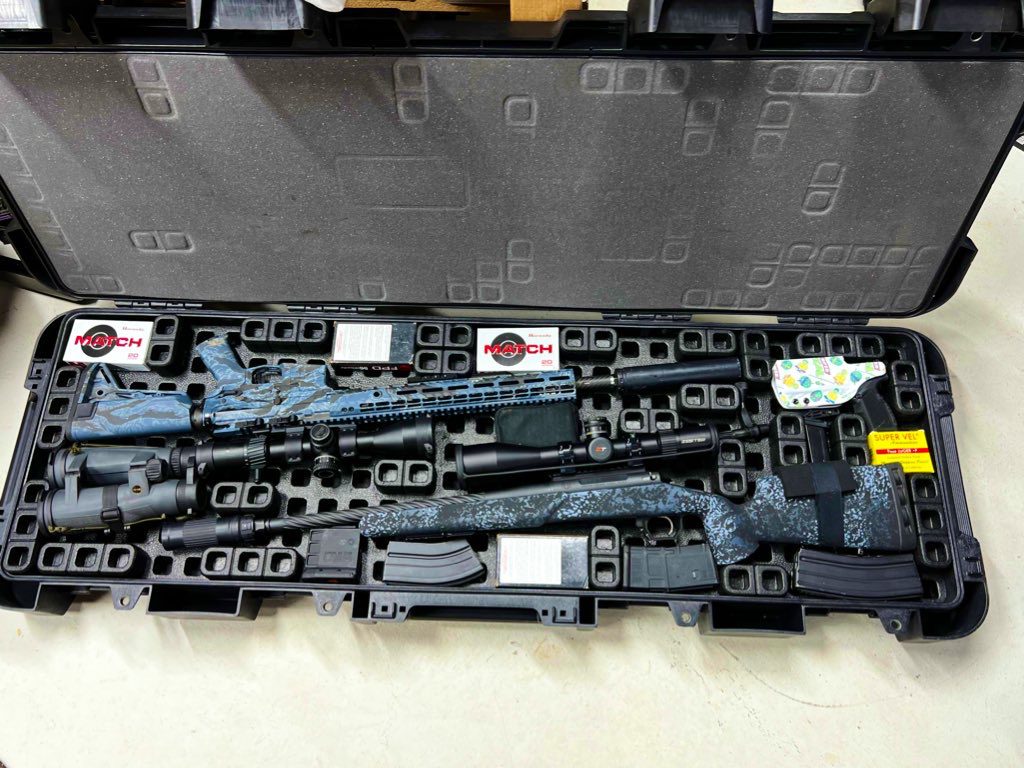
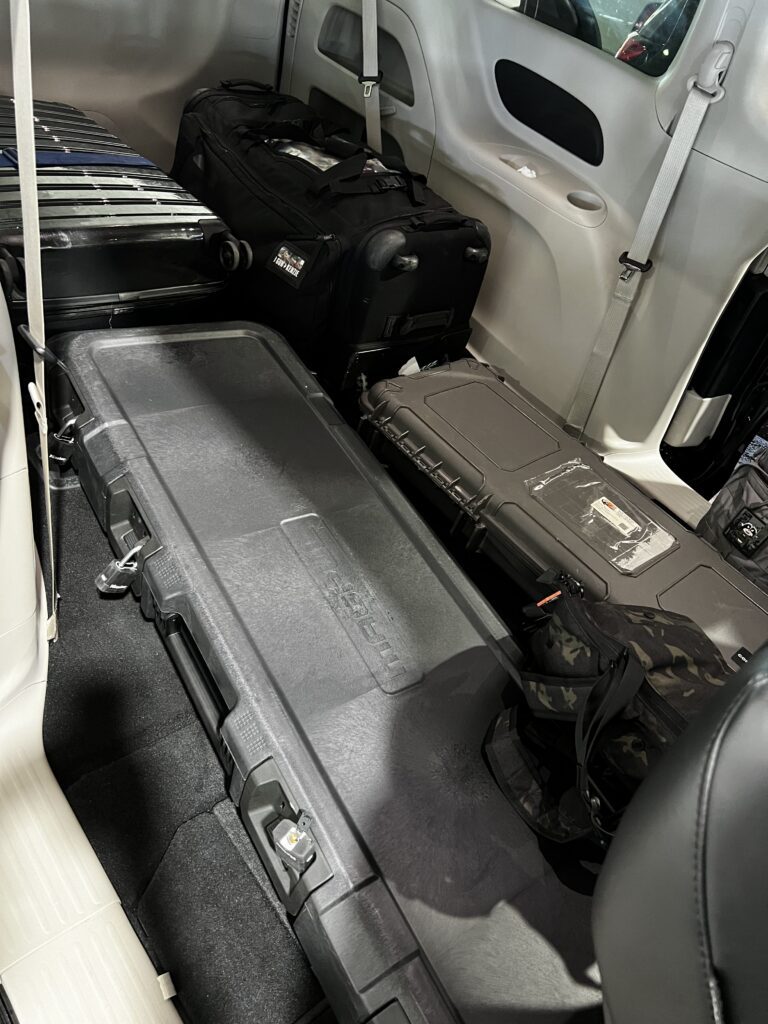
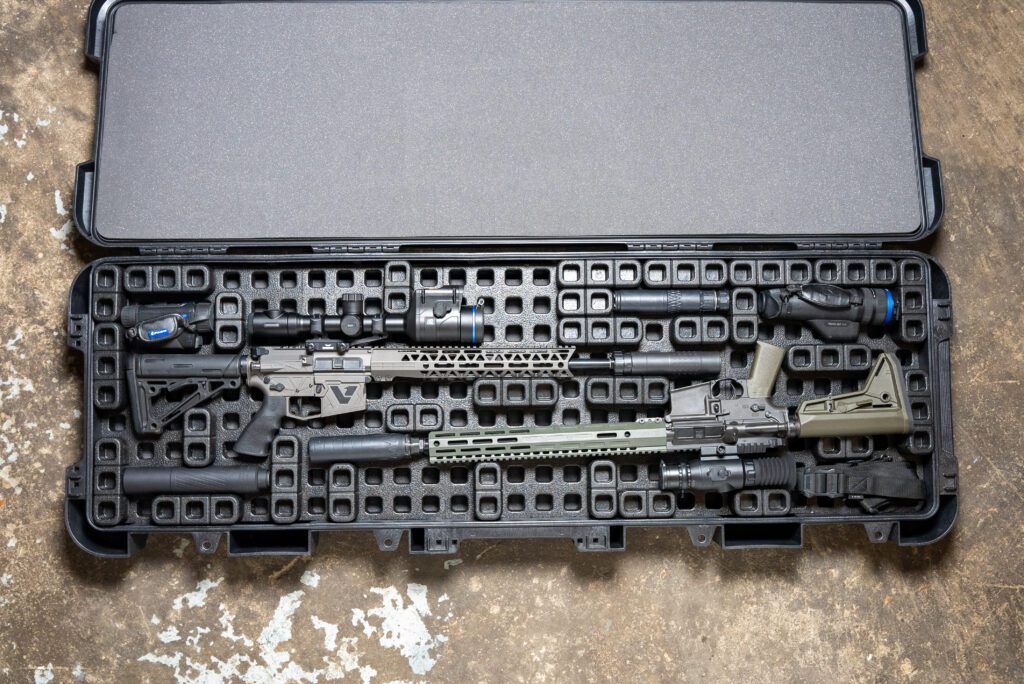
You have to have a hard case for traveling with firearms. It can be a pistol hard case that fits one gun, or a giant Magpul DAKA Hard case that holds all of them. I have flown all over the country with the Magpul LR53 hard case for 2 Gun Nationals, 3 Gun competitions, thermal hunting, and more, so I’ve needed all the space I can get. Obviously, a case this big is one checked bag itself. If you are only checking a handgun or two in a small hard case, you can put this case inside a checked bag so you do not have to check it separately. You will have to declare the firearm(s) inside, but if you only have the budget for one checked bag, be sure to leave space for you to put the pistol case inside once you declare the gun(s) with the airline.
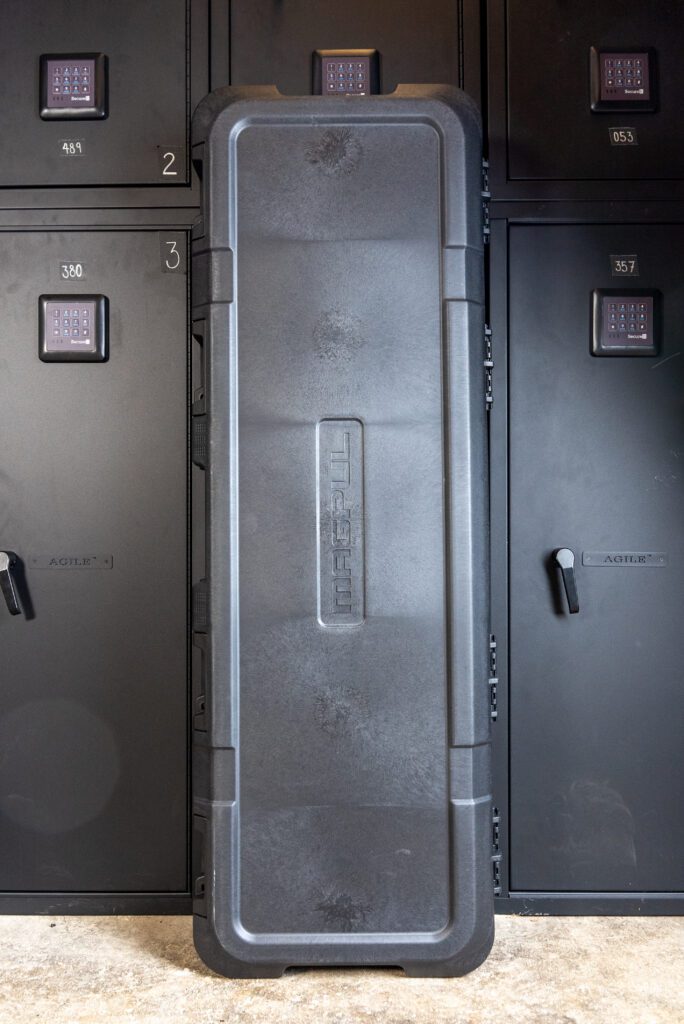
I recommend a hard case with multiple locking points and multiple holes for multiple locks. If you’re a knife person, you’ve probably heard the phrase “two is one, and one is none”. The same thing applies to locks here. I’ve had one Master Lock brand lock cut off a case before by TSA, and the joke was on them because I had three more that they couldn’t get through. It’s always a good idea to have a case that allows you to lock everything up as securely as possible because things will go wrong at some point if you fly enough.
Locks, All of the Locks!
TSA Rule: Only the passenger should retain the key or combination to the lock. You may use any brand or type of lock to secure your firearm case. (Updated as of August 12, 2026: Only the passenger should retain the key or combination to the lock unless TSA personnel request the key to open the firearm container to ensure compliance with TSA regulations. You may use any brand or type of lock to secure your firearm case, including TSA-recognized locks.)
Now that we’re talking about locks, you should have a lock for every hole available on your hard case. The DAKA hard case has four holes, so I bought a set of four Master Locks for that particular case. You can use any brand or type of lock, meaning a combination lock or a key lock. I recommend a key lock as they’re less likely to get damaged, and you can’t “guess” the combination to a key lock. I also like a hard shackle and not one made of cord or a malleable material. Those are easier to damage and cut through.
I do NOT recommend using any sort of TSA-compliant lock where they can access your guns without talking to you or your permission. TSA has been up to no good lately and has modified their website with new rules where you should hand over your key to TSA AND use TSA locks. I disagree completely with this, and in some scenarios I have been in, they’ve essentially broken federal law. Let me explain. I was coming back from a trip to Louisiana and was in the New Orleans terminal at my gate when I got a call from American Airlines that I needed to hand over my firearms hard case key to TSA for them to inspect my firearms. At the time, their rules online didn’t state anything about “sharing the key or combination upon request,” so that was completely illegal by their own ruleset. Not only that, but I had two guns inside the case with suppressors that I had Form 4’d, meaning I am the only person who can have access to my suppressors unless I am supervising someone else with them. If I handed over the key to someone to have access to the suppressors, that would mean I’d be breaking a pretty steep federal law. Now that TSA has written a rule that you can hand the key over to them upon request, I question which federal organization trumps which: the ATF or TSA. All of this to say, if you do comply with their demands to share the key with a TSA agent, make them work for it instead of using a TSA lock that they can access without you even knowing. I’d rather know and be ready to inspect my bag upon my arrival than not know, and have an issue that I’m now responsible for without knowing TSA could potentially share the blame.
Packing Your Guns and Ammunition
TSA Rule: Firearm magazines and ammunition clips, whether loaded or empty, must be securely boxed or included within a hard-sided case containing an unloaded firearm. Small arms ammunition (up to .75 caliber and shotgun shells of any gauge) must be packaged in a fiber (such as cardboard), wood, plastic, or metal box specifically designed to carry ammunition and declared to your airline. Ammunition may be transported in the same hard-sided, locked case as a firearm if it has been packed as described above. You cannot use firearm magazines or clips for packing ammunition unless they completely enclose the ammunition.
The TSA rule somewhat makes it easy to understand what to do with your ammunition, but I’m going to share my best practices with you to make it easy on yourself and the airline you plan to fly with. Some airlines prefer your ammunition in the original manufacturer’s box (or some sort of organized case/box) rather than loaded in a magazine, while others don’t mind if you have loaded magazines. Here’s what I recommend: just unload your magazines and keep all of your ammunition stored in boxes. It’s not worth the hassle or fight over loaded or unloaded magazines, so keep your ammunition boxes for the flight back in case you still come home with ammunition.
You should always check the airline policy you are flying with to know how much ammunition is allowed in your checked baggage. Delta and American Airlines, for example, allow up to 11 pounds of ammunition per person in your checked baggage. I have had several friends in the last few months get checked on this procedure and have had ammunition thrown away at the airport. If you know you have more than 11 pounds, just know you’re risking losing out on some precious metal.
TSA Rule: Firearm parts, including magazines, clips, bolts and firing pins, are prohibited in carry-on baggage, but may be transported in checked baggage. As defined by 49 CFR 1540.5 a loaded firearm has a live round of ammunition, or any component thereof, in the chamber or cylinder or in a magazine inserted in the firearm.
When it comes to packing your guns up, ensure the magazines are out of the firearms. You cannot carry on any magazines, so they need to stay in your hard case or go into a checked bag. You do not have to leave any actions open or any slides locked back. You do not have to have a chamber flag or empty chamber indicator either. These are common misconceptions, and nowhere in TSA rules does it talk about actions being locked to the rear. Your guns will be sent through the scanner, and it’s up to you to ensure the chambers are all empty. If you’re the forgetful type to check your chamber, it’s not a bad idea to travel with chamber flags or empty chamber indicators, more for your use to visually see that your guns are unloaded than for TSA use.
Airline Procedure for Traveling with Firearms
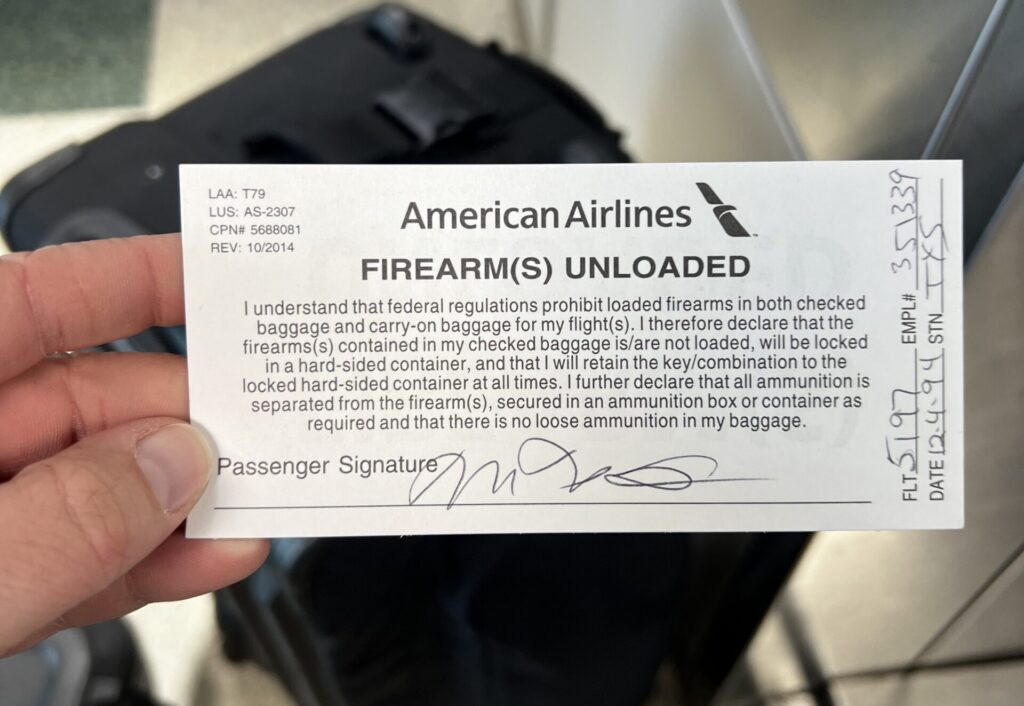
The check-in process is where traveling with firearms can get squirrely. Remember, you’re checking in with your airline, NOT with TSA, so this is where agents’ information can be massively wrong. I recommend NOT locking your hard case before getting to the airport because you’re going to have to put a signed document inside the hard case anyway, and unlocking a case, especially the DAKA hard case, is not a speedy process. When you get to the airport, you will have to see an agent, meaning you can’t go through the quick process of printing out your own bag tag. You will have to wait in line for the particular airline to help you check your bag. When you are seen by an agent, you must declare that you are checking firearms. They will hand you a “firearms unloaded” slip that you must sign, which ultimately declares you responsible for ensuring that your gun(s) are unloaded. When they hand you the completed slip, you will place this slip of paper INSIDE your hard case on top of your firearms. DO NOT tape it to the outside, throw it in your checked bag with your clothing if you’re transporting a hard case within another checked bag, or put it anywhere other than INSIDE the case. After the slip of paper is inside the hard case, lock your locks up, and triple-check that they are secure.
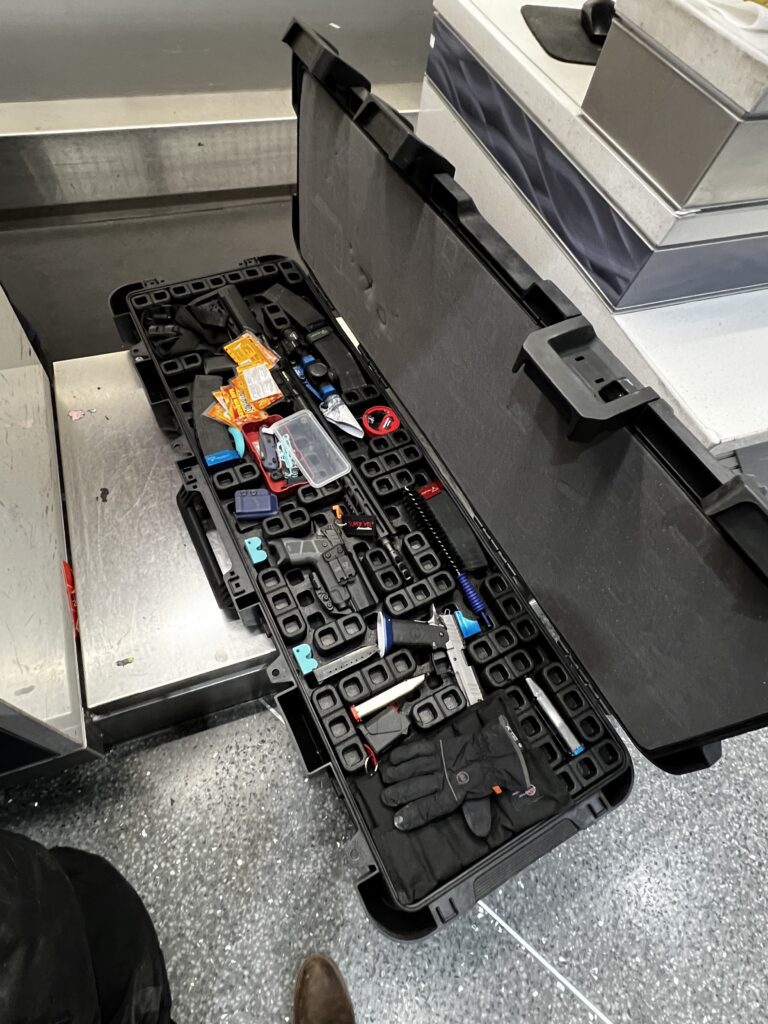
Every now and then, an agent might ask to look into the case or “see” that the guns are empty. I guarantee that more than half of the agents don’t have a clue what they’re looking at. I always fly with the slides forward on my handguns and my bolts forward on my semi-automatic rifles, meaning there’s no way to know if the chamber is empty unless you physically check it or until it goes through the scanner. I’ve played ball with a few agents who wanted to “inspect” them for themselves, where I’ve opened a case, like the one shown below, and they’ve confirmed the guns are empty just by nodding their heads… Yeah, they know nothing about firearms. If an agent asks you to physically handle your firearm, I always politely decline, as the only responsibility you have is to sign the “unloaded firearms” document and take responsibility for knowing your guns are unloaded.
My final pro tip for you, and many airlines are good about asking, is to stay near the check-in or baggage drop area for 10-15 minutes to ensure you aren’t called back to hand over your key or combination to TSA. Unfortunately, traveling with firearms means complications can arise, and my Magpul hard case hasn’t fit through a few scanners, so I’ve had to share my key (while being present in the room) with TSA while they have manually inspected my firearms. This is why it’s so crucial to arrive even earlier than you think to the airport when checking guns.
Backup Plans for Traveling with Firearms
Extra Locks
I’ve had many of the “worst-case scenarios” happen to me while traveling with firearms, so I’m here to try and help you avoid some rookie mistakes. It’s always a good idea to travel with extra locks, especially if you travel somewhere remote or without a rental car, where, if you need to go buy something, you have to drive a few hours or take an Uber to pick something up. Even if you keep one or two extra locks on hand, that is a great backup plan when your hard case should already have more than one on it.
 Tape, Zip Ties, Etc.
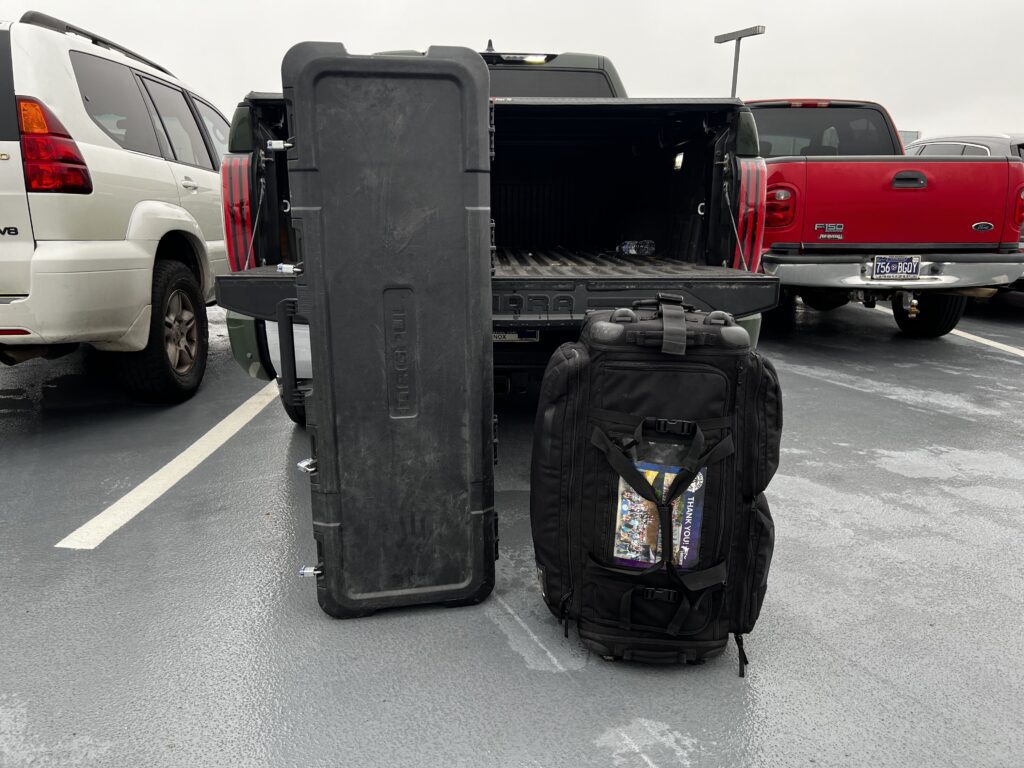
Your hard case is going to take a beating. Period. It just is. If you’ve flown at all, you’ve probably seen some damage done to your regular suitcase. Unfortunately, airline employees just don’t really care what’s in your case, and it’s up to you to secure everything internally and externally. If you land at your destination and have a broken hard case, you can get innovative with duct tape, zip ties, and other means of damage repair to make it “flyable” on your way back. On the flip side, I’ve seen Delta and some other airlines zip-tie firearm hard cases, which makes it super fun when you land and can’t access your firearms without scissors, a knife, or some sort of cutter. I always check knives in my checked luggage for this scenario, as I pretty much know airlines like to have fun with anyone traveling with firearms.
Print the Rules
If you want to be extra, print out TSA rules for flying with guns and the rules for whatever airline you’re traveling on. That way, if and when they make up rules on you or try to pull one over on you, you can have a complete guide for them to read on what’s required of you. I guarantee that after reading this article alone, you’ll know more than most airline employees about traveling with firearms.
Prepare for Printed Boarding Passes
I’m a millennial, and I’m a big fan of digital boarding passes. I love checking in online and love having my boarding passes loaded in my iPhone wallet. Well, guess what? Once you’ve flown to your destination on the first half of a round trip, you will not be able to check in via the mobile app or get boarding passes uploaded to your digital wallet. Most airlines (I haven’t seen one not do this yet) will not allow you to check in via the app on your way back home once they know you’ve got guns. You will repeat the same airline procedure for your flight back; only this time, you will be handed printed boarding passes. That’s probably my biggest pet peeve about traveling with firearms: this process makes no sense when it’s not like I can get through TSA with firearms or a giant 5-foot hard case anyway. There shouldn’t be any harm in me checking in for my flight back or receiving my digital boarding passes on my phone.
 Pack Your Patience
Here’s the last thing I’ll leave you with for this experience. You could be someone’s first encounter ever with a gun owner, so your attitude and patience are super important. The airport is one of my least favorite places on earth, but it is necessary for me to get to a lot of places I want to go. Arrive extra early when you have firearms, pack your patience, and remember that you are representing gun owners all over the world.
